

If you’ve ever wondered what is a node in computer networking, the answer is hiding in plain sight — your phone, your laptop, your home router. Every one of them is a node. And without nodes, there’s no network, no emails, no cloud access. Nothing moves.
So what exactly is a node in computer networking, and why does it matter more in 2026 than ever before?
A network node is any physical device or virtual component that serves as a connection point within a network — an active device capable of creating, receiving, storing, or transmitting data over a communication channel. That’s the technical definition. But the practical reality goes much deeper.
What a Node Actually Does in a Network
Think of a network like a road system. Data is the traffic. Nodes are the intersections, the fuel stations, the toll booths, and the destinations — all rolled into one concept, depending on the type of node you’re talking about.
When one device sends data to another, the data is divided into packets and transmitted to the nearest node. That node then forwards the packets to the next node in the sequence, continuing the process until the data reaches its final destination. Network nodes use protocols like TCP/IP to communicate, ensuring data moves efficiently and reliably.
Not all nodes are endpoints. Some are intermediate nodes that don’t create or terminate data but instead direct it to the appropriate destination — routers and switches being the clearest examples. Others are centralized nodes known as servers, which store data and provide resources to the rest of the network.
So the moment you hit “send” on a message, you’ve already triggered a chain of node-to-node handoffs happening in milliseconds across infrastructure most people never see.
What Is a Node in Computer Networking: Main Types Explained
Understanding what a node in computer networking looks like in practice means looking at its different forms. They’re not all alike — and the differences matter a great deal for how networks are designed.
End Nodes (Client Devices)
End nodes — computers, smartphones, tablets — serve as the source or destination points in network communication. They initiate or terminate communication and are the primary users of network resources. Your laptop right now is an end node. So is the server responding to your browser request.
Intermediate Nodes (Routers and Switches)
A gateway is a network node that connects discrete networks or systems using different protocols, enabling data to flow between them. After a gateway processes a data packet, it typically forwards it to a router, which sends the packet toward its destination within the network.
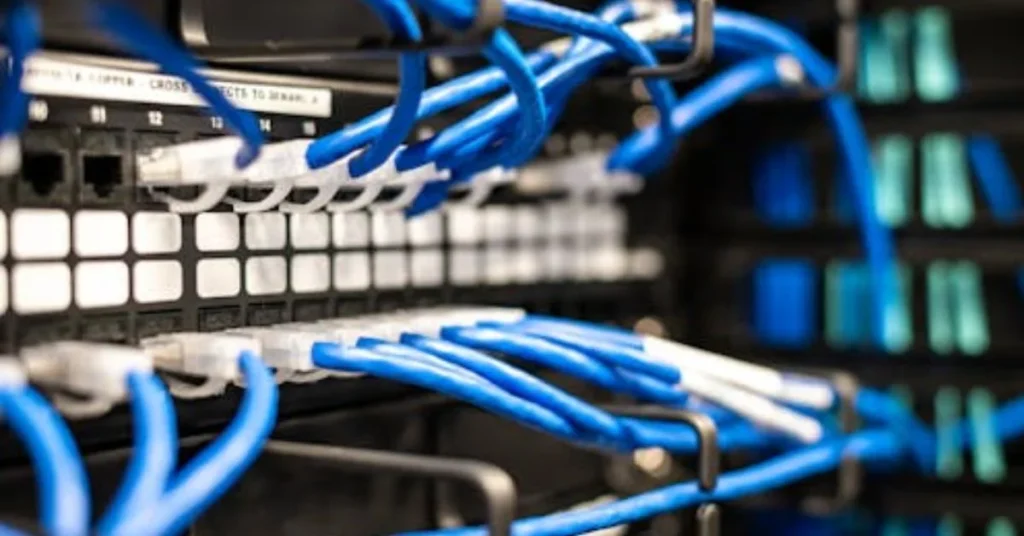
Routers and switches are the workhorses here. A network switch forwards data to its destination by examining an incoming frame’s MAC address and sending it to the device with the matching address, allocating dedicated bandwidth per port — unlike a hub, which shares bandwidth across all connections and can cause collisions.
Server Nodes
Servers are centralized nodes that don’t just pass data — they store it, process it, and respond to requests. When you load a webpage, a server node somewhere receives your request, processes it, and sends back the content your browser renders. Web hosting, cloud storage, database management — all of it runs on server nodes. For professionals who need to access their work PC remotely, understanding how server and endpoint nodes communicate is what makes remote desktop setup possible.
IoT Nodes
This category has exploded. The global IoT market is valued at $714.48 billion in 2024 and projected to exceed $4 trillion by 2032, with an estimated 21.1 billion IoT devices worldwide by the end of 2025 — growing at 14% year over year. Every smart sensor, connected camera, industrial monitor, and wearable device is a node on some network. The scale is genuinely staggering.
How Node Identity Works: IP Addresses and MAC Addresses
Every node that participates meaningfully in a network needs an identity — some way for other nodes to find it and send data its direction.
On the internet or an intranet, many physical network nodes are host computers identified by an IP address. However, some data-link-layer devices like switches, bridges, and wireless access points don’t have an IP host address and are considered physical network or LAN nodes rather than internet nodes.
More specifically, a computer’s Network Interface Card (NIC) is technically the node — it’s the connection point of the device to the network, through which data transfers and a network address is assigned.
So when someone says “add a node to the network,” what they actually mean is: connect a device that can communicate using the network’s established protocols, and give it an address so everything else knows where to find it.
What Is a Node in Computer Networking Across Different Topologies
The role of any given node shifts depending on how the network is structured — its topology.
In network topology, a node represents a connection point where two or more network links intersect. These nodes define the structure of the network itself — whether it’s a bus, star, or mesh topology.
In a star topology, all nodes connect to one central node — typically a switch or hub. If the central node fails, communication across the network breaks. In a mesh topology, every node connects to multiple other nodes, creating redundancy. If one path fails, data reroutes through another. Enterprise networks and the internet backbone both rely heavily on mesh logic.
In client-server networks, the server is a central node that handles requests from many client nodes. In peer-to-peer networks, each node can act as both client and server simultaneously.
The topology choice isn’t just technical preference — it affects cost, resilience, speed, and how difficult the network is to manage at scale.
What the Research Shows
Network nodes aren’t just a textbook concept. They’re the physical and logical substrate everything digital runs on, and the scale of deployment in 2026 reflects that clearly.
IDC estimates that connected IoT devices will generate 79.4 zettabytes of data in 2025 — a figure that underscores just how much node-level activity is happening continuously across global infrastructure. One zettabyte equals one trillion gigabytes. The math is difficult to fully absorb.
Professionals working in network architecture consistently report that node management — knowing what’s on your network, what each node is doing, and where failures are occurring — has become one of the most demanding parts of modern IT operations. As networks grow in device count and geographic spread, visibility into node behaviour is increasingly the difference between a stable operation and an outage.
The pattern emerging across enterprise IT in 2026 is that node security has moved from a niche concern to a baseline requirement. Every unmanaged node is a potential entry point, and threat actors know it.
Nodes and Network Security: The Risk Factor Nobody Ignores
Any device on a network is a potential vulnerability. That’s been true for years, but the explosion of IoT nodes has made it dramatically harder to manage.
IoT cyberattacks reached 112 million incidents in 2022, up 87% year over year — and the attack surface has only grown since. Every new node added to a network without proper authentication, patching, or monitoring is a door left slightly ajar.
Network administrators track nodes through network management tools, SNMP protocols, and device inventories. The goal is always the same: know every node, understand what it should be doing, and catch any behaviour that deviates from the expected pattern. Rogue nodes — devices connected to a network without authorisation — are one of the most common vectors for internal security breaches.
For home users, this translates simply: every device on your Wi-Fi is a node. Your smart TV, your gaming console, your thermostat. Each one should be considered in terms of whether it’s getting firmware updates and whether it really needs to be on the same network segment as your laptop.
Nodes in Telecommunications Networks
The concept extends beyond computer networks. In the fixed telephone network, a node may be a public or private telephone exchange, a remote concentrator, or a computer providing some intelligent network service.
A telecommunications network is a group of nodes interconnected by telecommunications links used to exchange messages. Multiple nodes cooperate to pass a message from an originating node to a destination node via multiple network hops, with each node assigned a network address for identification and location on the network.
The same underlying logic — point A to point B through a chain of intermediate handoffs — applies whether you’re sending a data packet across the internet or a voice call through a legacy telephone exchange.
Common Node Misconceptions Worth Clearing Up
“Only computers are nodes.” Not true. Printers, cameras, smart bulbs, game consoles, NAS drives — if it connects to a network and has an address, it qualifies.
“Nodes and servers are the same thing.” Servers are one type of node, but nodes are a much broader category. A router is a node. A smartphone is a node. A server is a node too — just a specific kind with a specific function.
“Adding more nodes makes a network slower.” Not inherently. Poor network design makes a network slower. Adding nodes with proper infrastructure — appropriate switching, sufficient bandwidth, logical segmentation — actually extends capability without degrading speed.

FAQs
Q: What’s the simplest definition of a node in networking?
A node is any device or connection point in a network that can send, receive, or forward data. Your phone, your router, and the server hosting your favourite website are all nodes.
Q: Is a router a node?
Yes. A router is an intermediate node — it doesn’t originate or terminate data, but it reads packet headers and directs traffic toward the correct destination.
Q: Can a node be wireless?
Absolutely. Wi-Fi access points, smartphones, and IoT devices are all wireless nodes. The connection medium — cable, fibre, or wireless signal — doesn’t change whether something qualifies as a node.
Q: What’s the difference between an end node and an intermediate node?
End nodes are where data originates or arrives — your computer, your phone. Intermediate nodes sit in between, directing traffic without being the source or destination. Routers and switches are the most common examples.
Q: Why does the number of nodes on a network matter for security?
Every node is a potential attack surface. Unmanaged, unpatched, or unauthorised nodes are entry points for threats. Knowing exactly what’s on your network — and what each device is doing — is foundational to network security in 2026.
