


Starting a business in Massachusetts? Or vetting a company before signing a deal? Either way, the Massachusetts corporation search tool is the first stop — and most people don’t use it to its full potential.
The Massachusetts Secretary of the Commonwealth offers public access to official business filing records through its Corporations Division online portal. No fees. No account required. Just raw, verified state data anyone can pull up in seconds.
Here’s exactly how it works, what it tells you, and why it matters more than people realise.
What the Massachusetts Corporation Search Actually Is
The Massachusetts Business Entity Search is an official online database maintained by the Secretary of the Commonwealth’s Corporations Division. It allows users to search for information about businesses registered in Massachusetts — including corporations, LLCs, limited partnerships, and nonprofits. Unlike some states that require payments or subscriptions, Massachusetts offers this service completely free of charge to the public.
The database covers every entity that has ever filed with the state. That includes businesses long dissolved, currently active, administratively revoked, or suspended. Each record is a snapshot of that company’s full legal history with the Commonwealth.
As of 2026, around 29,863 new businesses were projected to form in Massachusetts within a single four-quarter window — meaning the database is constantly growing, and names you want today may not be available tomorrow.
How to Run a Massachusetts Corporation Search
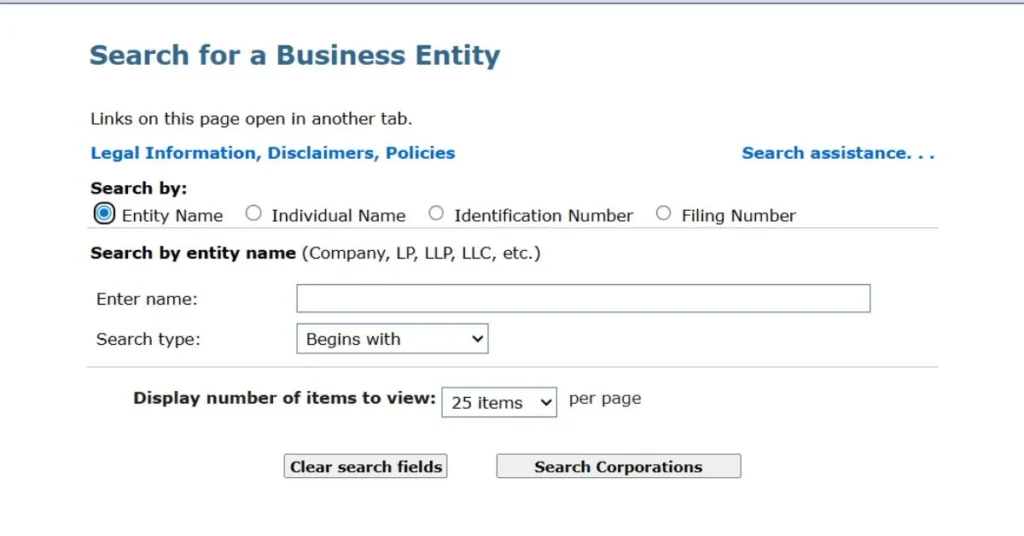
The official search portal is at: https://corp.sec.state.ma.us/corpweb/CorpSearch/CorpSearch.aspx — the Massachusetts Secretary of the Commonwealth’s Corporations Division website.
Once you’re on the page, you get four distinct search options:
The Corporations Division database allows searches by entity name, individual name, identification number, or filing number. Results include detailed public information such as business address, officers, filing history, and standing status.
- Searching by entity name is the most common route. Leave out “LLC” or punctuation at the end of the name. Don’t worry about capitalisation either. Enter only the first one or two words to broaden your results. That pulls up a wider list — better than missing a match due to a spelling variation.
- Searching by individual name is useful when you know who runs the company but not what it’s called. Officers and directors are listed on file, so you can find every entity a specific person is attached to.
- Searching by ID number is the cleanest method when you have the exact state-assigned number — no ambiguity, no similar-name noise.
What You Find When You Search
Each record shows the entity name and type, state ID number, formation date, last annual report filed, jurisdiction (Massachusetts or a foreign state), and current status — Active, Dissolved, or otherwise.
The status field is where most people focus first — and rightly so. If the “Status” field reads “Active,” the entity is in good standing. If it shows “Dissolved,” “Revoked,” or “Administratively Dissolved,” that’s a significant red flag for anyone entering a deal with that company.
Corporate records — including Articles of Organization, bylaws, board resolutions, and annual reports — are governed by Chapter 156D of the Massachusetts General Laws. The search portal surfaces most of this filing history directly in the results.
Who Uses This Tool — and Why
The answer is: more people than you’d expect.
Entrepreneurs checking name availability. The Massachusetts Secretary of State doesn’t publish its exact rules for what makes a business name “distinguishable.” General guidance says differences in designators alone — LLC vs. Inc. vs. Corp — don’t create distinguishability. Adding filler words like “the,” “a,” “and,” or “of” won’t make a name available either. So you need to search carefully, not just confirm your exact name isn’t taken.
A name reservation process allows a 60-day hold on a corporate name, renewable once for an additional 60 days, with a $30 filing fee. That’s your window to file the real paperwork without someone swooping in.
Investors doing pre-deal diligence. Anyone considering a transaction with a Massachusetts-based company should verify its standing before moving a dollar. A quick search reveals the company’s current status and whether it’s authorised to conduct business in the state. An entity operating on a lapsed registration is a liability, not a partner.
Attorneys and compliance teams. Shareholders have limited inspection rights and must show a proper purpose for record requests. Legal professionals routinely use the database to confirm standing, track filing history, and support litigation or regulatory work.
Consumers verifying vendors. Before wiring money to a contractor or service provider, a 30-second corporation search confirms whether the business actually exists as a registered legal entity.
What the Research Shows
Detailed analysis of how Massachusetts business data is structured reveals a few things practitioners notice quickly:
The “Begins With” search type is the default — but not always best. Switching to “Contains” in the dropdown pulls up matches where your keyword appears anywhere in the name, not just at the start. That catches DBA variations and partial name matches the default setting misses.
Filing history is cumulative. Every amendment, annual report, name change, and registered agent update is preserved. The search returns results immediately with all entity details visible on the summary page, including entity name, type, number, and formation date. Skimming the filing log often tells you more about a company’s stability than its current status alone.
The Corporations Book adds another layer. The Corporation Book Online Search lets you search for Massachusetts corporations, financial institutions, and insurance companies using keywords — with results that can be exported in Microsoft Excel format. That’s useful for bulk research or building a competitor landscape.
UCC and trademark searches complement the corporation database. You can also perform trademark, UCC lien, and court record searches to identify potential conflicts or liabilities before forming a business. The corporation search alone won’t surface financial encumbrances — those require a separate UCC filing search.
Massachusetts Corporation Search for Name Availability
This is where most first-time users focus — and where the most mistakes happen.
People search their exact proposed name, don’t find it, and assume they’re clear. That’s not how it works.
If your desired LLC name is “Chickadee Chimneys LLC,” it’s not available if any of the following exist in the results: Chickadee Chimneys Inc., Chickadee Chimneys Corp., Chickadee Chimneys L.L.C. — the designator alone doesn’t create distinguishability.
Search broad. Search partial. Search variations. Then call the Corporations Division directly if you’re still unsure — they can help you check whether a name is available before you file your LLC paperwork.
Name distinguishability rules in Massachusetts prevent businesses from using names too similar to existing entities. What counts as “too similar” is a judgement call the state makes — not something the database will flag automatically.
Common Search Mistakes to Avoid
Don’t include legal designators in your search. Typing “Acme Solutions LLC” instead of “Acme Solutions” cuts your results. The system handles the designator separately.
Don’t assume dissolved means irrelevant. A dissolved entity’s name can still conflict with a new registration if the state determines the names are too similar.
Don’t rely only on the name search. If you’re vetting a company rather than checking name availability, run their ID number too. It bypasses any name discrepancies or typos.
Don’t skip the annual report date. A company that hasn’t filed its annual report in two or three years may be technically “active” in the database but functionally inactive in practice.
Benefits of Registering a Business in Massachusetts
Since you’re already in the database, it’s worth knowing what you’re looking at.
Registering a business in Massachusetts provides significant advantages — strong legal liability protection for personal assets, access to a highly skilled workforce, and a robust innovative economy. Businesses benefit from tax flexibility (pass-through taxation for LLCs), access to specialised top-tier industries, and state-sponsored economic incentives. The state also offers access to investors and a highly educated workforce.
That’s why the Massachusetts corporation search database is as busy as it is — the state is genuinely attractive for businesses at every stage.
Massachusetts Corporation Search: The Bottom Line
The Massachusetts corporation search tool is one of the most underused public resources in the state. Whether you’re launching your first LLC, evaluating a supplier, or investigating a competitor’s corporate structure, everything you need is sitting in that free public database maintained by the Secretary of the Commonwealth.
Run the search before you form. Run it before you sign. And run it before you pay. The Massachusetts corporation search takes under a minute and can save months of legal headaches. In 2026, there’s no reason to skip this step.

FAQs
1. Is the Massachusetts corporation search completely free?
Yes. The Corporations Division database is open to the public at no cost. No registration, no subscription, no per-search fee.
2. What’s the difference between “Active” and “Good Standing” status?
“Active” means the entity is currently registered. “Good Standing” typically implies all required annual reports and fees are current. An entity can sometimes be “Active” but behind on filings — always check the annual report date.
3. Can I search by the name of a person who owns or runs a company?
Yes. The individual name search pulls up all entities where that person appears as an officer, director, or registered agent.
4. How do I reserve a business name in Massachusetts?
File a name reservation application with the Secretary of the Commonwealth. The fee is $30 and the reservation lasts 60 days, with one renewal allowed for another 60 days.
5. Does the corporation search show if a company has any liens or lawsuits against it?
No — those require separate UCC lien and court record searches. The corporation database covers registration, filing history, and standing only.
