


Search has changed — quietly, and faster than most people realize. AEO, short for Answer Engine Optimization, is the discipline that’s now separating brands that show up in AI-generated answers from those that simply don’t exist in that space. If your content isn’t built for this shift, you’re already losing ground you don’t know about.
This isn’t a tweak to the old playbook. It’s a different game.
What AEO Actually Means — and Why It Emerged
AEO is the practice of optimizing your content so that search platforms can directly provide answers to user queries, rather than just listing links. It focuses on making your content the answer that engines deliver to users — whether through featured snippets, voice assistant responses, or AI-powered chat results.
The reason this matters right now comes down to one thing: user behavior. ChatGPT now reaches 883 million monthly users, and Google AI Overviews appear in nearly 55% of all Google searches. Meanwhile, Gartner predicts traditional search volume will drop 25% by 2026 due to AI chatbots and virtual agents.
That’s not a future forecast. That’s already happening.
In 2026, many users begin with an AI-generated answer, a synthesized overview, a voice response, or a conversational interface that pulls from multiple sources at once. That shift has changed how brands earn visibility. Your content doesn’t just need to rank anymore. It needs to get cited.
AEO vs SEO — Two Layers, Not Two Choices
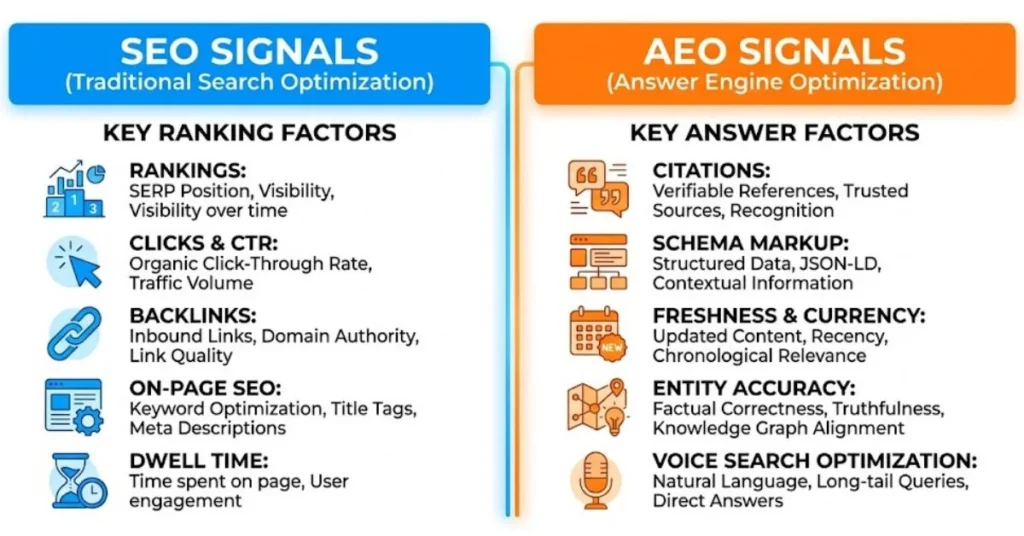
A lot of people pit these against each other. That’s the wrong framing.
While AEO and SEO are often discussed as competitors, they are best understood as distinct layers of the same infrastructure. SEO provides the access — crawlability — while AEO provides the answer — synthesizability.
Here’s the practical difference: SEO drives website traffic; AEO shapes how AI represents your brand when buyers skip search entirely. And increasingly, buyers are skipping search entirely.
Strong SEO gets content indexed and discovered. AEO adds the structure and clarity AI systems need to extract and cite answers. Both are required for comprehensive search visibility in 2026.
Think of it this way. SEO gets you in the building. AEO gets you on stage.
What the Research Shows
The numbers coming out of AEO research are hard to ignore.
AI-referred sessions to websites grew 527% year-over-year through mid-2025. That’s not a niche metric — that’s a channel that didn’t meaningfully exist two years ago now sending half a billion percentage points more traffic.
AirOps research found that for commercial and evaluation-stage queries, 83% of AI citations came from pages updated within the past 12 months, with more than 60% refreshed within the last six months. Freshness isn’t just a nice-to-have — for AEO, it’s a core ranking signal.
And on the schema side: A Data World benchmark found LLMs grounded in structured knowledge graphs produced up to 300% higher accuracy than those working from raw text alone. Structure doesn’t just help humans read your content. It helps AI trust it.
The Tinuiti Q1 2026 AI Citation Trends Report tracked high commercial-intent prompts across seven AI platforms — ChatGPT, Perplexity, Google AI Mode, Google AI Overviews, Google Gemini, Microsoft Copilot, and Meta AI — over four months ending January 2026. The core finding: citation behavior varies by platform. There’s no single universal winner. Which means brands need to cover structure, freshness, and credibility together — not pick one.
How AEO Works in Practice
In practical terms, AEO means your content must do more than contain keywords. It must provide clear answers, demonstrate expertise, resolve ambiguity, reflect real entities, and be packaged in a structure machines can parse without guessing.
Here’s what that looks like when you break it down:
- Answer-first formatting. AI engines don’t hunt for your main point buried in paragraph seven. They extract. If your answer isn’t in the first two sentences after a heading, there’s a real chance it gets skipped.
- Schema markup. Structured data — product, review, organization — provides the context cues essential for AI to parse and verify your brand’s authority. Think of schema as machine-readable labels on your content. Without them, AI is guessing.
- Credible sourcing. Structure, freshness, and credible sourcing are the three variables teams can control that most reliably predict whether a page gets cited or skipped.
- Topical depth. AI systems don’t cite shallow content. A page that answers one question well, then raises and answers follow-up questions naturally, signals genuine expertise. That’s what gets pulled.
AEO and Revenue — The Connection Brands Miss
Most conversations about AEO stay at the visibility level. But there’s a business case that goes deeper.
AEO can directly impact revenue. Although many prompts typed into AI tools are informational, many are looking for comparisons during the buyer journey phase — when someone wants to make a purchase or even push “buy” on a product.
Those aren’t low-stakes moments. A buyer who asks ChatGPT “what’s the best project management tool for remote teams” and gets a cited response recommending a specific brand — that’s a conversion touchpoint that never touches your analytics. Consider indirect conversion paths, like users who hear your brand via a voice assistant and later visit directly.
AEO also operates at the top of the funnel in ways traditional SEO can’t. Answer engines now handle a growing share of early and mid-stage research, which means buyers can form preferences before they ever reach your site.
That’s brand imprinting. And it’s happening whether or not you’ve optimized for it.
The Practical AEO Checklist for 2026

Anyone managing content for a business right now should be working through this:
- Lead every section with a direct answer. Don’t bury the point.
- Update key pages every 6 months minimum. Freshness signals matter.
- Add schema markup — particularly Article, Organization, HowTo, and Author schema.
- Write for questions, not just keywords. “What is…”, “How does…”, “Why should…” framing structures content the way AI engines think.
- Build topical clusters. One strong pillar page plus supporting content covering adjacent questions tells AI systems you own this space.
- Track citation metrics. Track citation frequency, competitive citation share, question coverage, and assisted conversions alongside traditional metrics.
Where AEO Sits in the Bigger Picture
AEO is a component of the broader discipline known as Generative Engine Optimization (GEO). While GEO encompasses all strategies for optimizing content across generative AI platforms, AEO focuses specifically on the answer-retrieval layer — ensuring your content is the one that gets selected when an AI engine needs a source for a specific fact, definition, or recommendation.
As of 2026, ChatGPT processes queries from 700 million weekly users, and Google AI Overviews reaches 2 billion monthly users. That’s the scale of the opportunity — and the risk for brands that haven’t moved yet.
The brands investing in AEO now will earn disproportionate attention, trust, and demand as AI search continues to grow. That’s not hype — it’s the logical outcome when a channel this large is still being ignored by the majority of content teams.
If you’re running SEO campaigns without an AEO layer, you’re optimizing for a search experience that’s already shifting under your feet.
Also Read: Warmup Cache Request: The Hidden Fix Killing Your Page Speed
FAQs
What is AEO in simple terms?
AEO stands for Answer Engine Optimization. It’s the practice of structuring your content so that AI-powered platforms like ChatGPT, Perplexity, and Google AI Overviews select it as a source when generating answers to user questions.
Is AEO replacing SEO?
No — they work together. SEO helps your content get indexed and discovered. AEO helps AI systems extract and cite it. In 2026, you need both to cover the full search landscape.
What kind of content performs best for AEO?
Content that leads with a clear, direct answer, uses proper schema markup, covers a topic with real depth, and has been updated recently. Shallow or keyword-stuffed pages rarely get cited by AI engines.
How do I know if my content is being cited by AI?
Tools like OmniSEO and similar emerging AEO trackers let you monitor citations across AI platforms. You can also test manually by searching your core topics directly in ChatGPT, Perplexity, and Google AI Mode.
Does AEO work for small websites or just big brands?
It works at any scale. Smaller sites with well-structured, genuinely helpful content have outperformed large brands in AI citations — particularly in niche topics where depth beats volume.
