
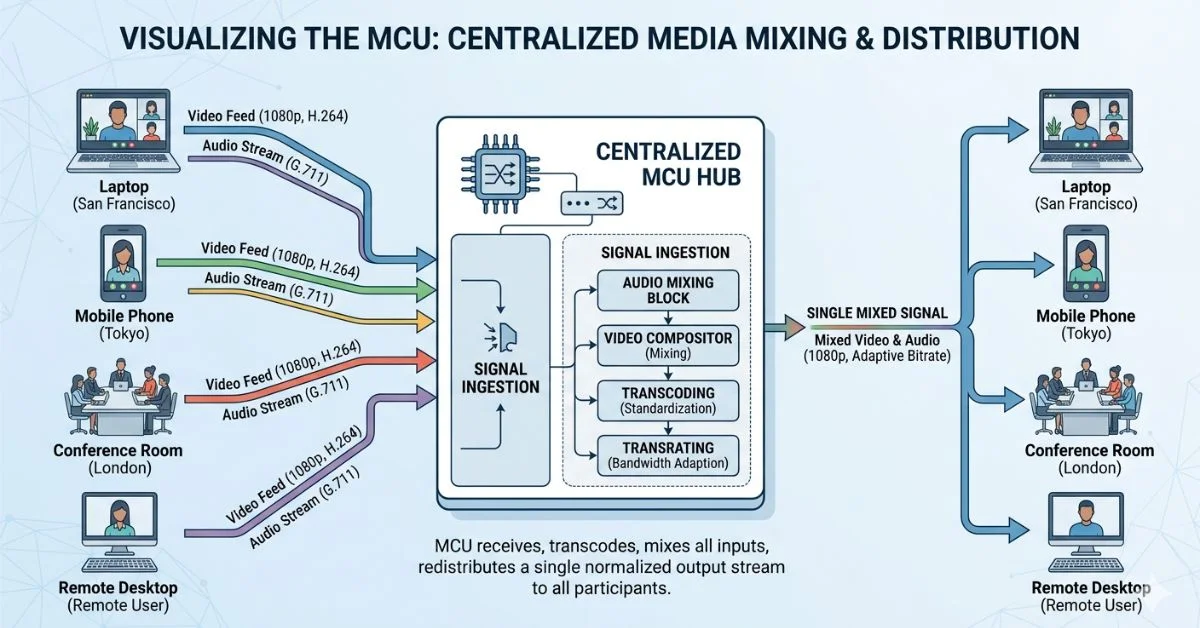

Every time you join a video call with three or more people, something invisible kicks into gear behind the scenes. That something is a multipoint control unit — the MCU — and most of the people who rely on it have never heard of it. That’s almost by design. When it works well, you don’t notice it. But without it, multi-participant video conferencing as we know it simply wouldn’t function.
As of 2026, with hybrid work firmly embedded across industries and global teams meeting in real time across continents, understanding how the MCU works has become relevant not just for network engineers — but for anyone designing, deploying, or evaluating enterprise communication infrastructure.
What Exactly Is a Multipoint Control Unit?
Strip away the jargon and the MCU is straightforward in concept. It’s a dedicated hardware appliance or software application that facilitates conferences between three or more endpoints by connecting them into a single virtual meeting. Think of it as a conference switchboard — but instead of patching phone lines, it’s processing simultaneous audio and video feeds from dozens or even hundreds of participants.
Before the advent of MCUs, video conferencing was strictly limited to point-to-point connections between two locations. MCUs completely revolutionized this by enabling multi-party calls through centralized media mixing—merging the audio, video, and data from every endpoint into a single, unified stream distributed back to all participants.
That shift — from two-point to multipoint — changed business communication entirely.
In the common “continuous presence” mode, the screen is split into one large and several smaller windows, with the MCU sending the video of the dominant speaker to the large window. An audio bridge mixes the audio from all endpoints. That familiar split-screen grid you see in every video call? The MCU built that.
How the Multipoint Control Unit Processes Audio and Video Streams
Here’s where things get technically interesting. The MCU doesn’t just relay feeds — it actively processes them.
Each participant’s audio, video, and data streams are captured by their respective devices and sent to the MCU. Here, these disparate signals undergo processing: they’re synchronized, mixed, switched, and then redistributed back to all participants involved in the call.
Three specific processes sit at the core of that workflow:
- Mixing — combining multiple video feeds into a single composite layout that all participants receive
- Transcoding — converting video from one format or codec to another so devices using different standards can communicate
- Transrating — adjusting the data rate of a video stream to suit available bandwidth conditions
MCUs use various algorithms to optimize video and audio quality and reduce bandwidth consumption. They can adapt the video feeds’ resolution, frame rate, and bitrate based on available bandwidth and the devices people are using.
This adaptive processing is what keeps a call stable when one participant is on fiber and another is on a shaky mobile connection. The MCU absorbs the inconsistency and delivers a normalized output to everyone on the call.
The Mesh Network Scalability Problem
In a traditional peer-to-peer mesh network, every user must establish a direct connection to every other participant. This creates a massive bandwidth overhead that scales exponentially according to the formula:
$$N \times (N – 1)$$
For a 20-person call, this demands an unsustainable 380 individual connections across the network. The MCU elegantly solves this bottleneck by acting as a single, centralized connection hub for each device, dropping the total workload down to just 20 connections.
N * (N – 1)
For a 20-person call, that’s the difference between 380 individual connections and 20. The efficiency gain is not trivial.
The Two Core Components Inside a Multipoint Control Unit
Technically speaking, the MCU isn’t a single monolithic thing — it’s two logical systems working together.
A traditional hardware-based MCU comprises two main logical components: the Multipoint Controller (MC), the “brain” of the operation that handles the signaling layer — H.323 or SIP protocols that set up, manage, and tear down the call — and negotiates capabilities between endpoints, manages the conference roster, and determines the rules for audio mixing and video layout.
The second component is the Multipoint Processor (MP), which handles the actual media work — decoding incoming streams, mixing or switching them, and re-encoding the output for distribution. The MC thinks; the MP does.
The MCU also improves compatibility between old and new systems, converts between SIP and H.323, and thanks to first-class upscaling algorithms often achieves higher quality than point-to-point operation.
That cross-protocol compatibility is one reason MCUs remain relevant in enterprise environments where legacy room systems running H.323 sit alongside modern SIP endpoints and cloud-based clients.
What the Research Shows: MCU vs SFU Performance Data
The more pressing question for network architects in 2026 isn’t really “what is an MCU” — it’s “should we still use one?” And the honest answer is: it depends on what you’re optimizing for.
While MCUs deliver incredible client-side efficiency, modern architecture heavily favors SFUs for public cloud scale. A direct analysis of cost, latency, and video fidelity metrics highlights the dramatic operational trade-offs between the two infrastructures:
| Performance & Financial Metric | MCU (Multipoint Control Unit) | SFU (Selective Forwarding Unit) |
| Infrastructure Cost (per 1k users) | $2,000 – $5,000 / month | $300 – $500 / month |
| Network Latency | 200 – 400 ms | 100 – 200 ms |
| Video Quality Score (VMAF) | 60.3 (Baseline) | 70.2 (Improved) |
| Peak Signal-to-Noise Ratio (PSNR) | 35.2 dB | 40.1 dB |
| Average Frame Rate Output | 28.4 FPS | 32.1 FPS |
These metrics make the choice clear: SFUs dominate mass-scale, cloud-native enterprise deployments where budget and low latency are prioritized. However, the raw numbers don’t make the MCU completely obsolete—they simply redefine exactly where this architecture belongs.
The SFU advantage in modern, cloud-native deployments is real. But it doesn’t make MCUs obsolete — it changes where they belong.
MCU vs SFU: When Each Architecture Makes Sense
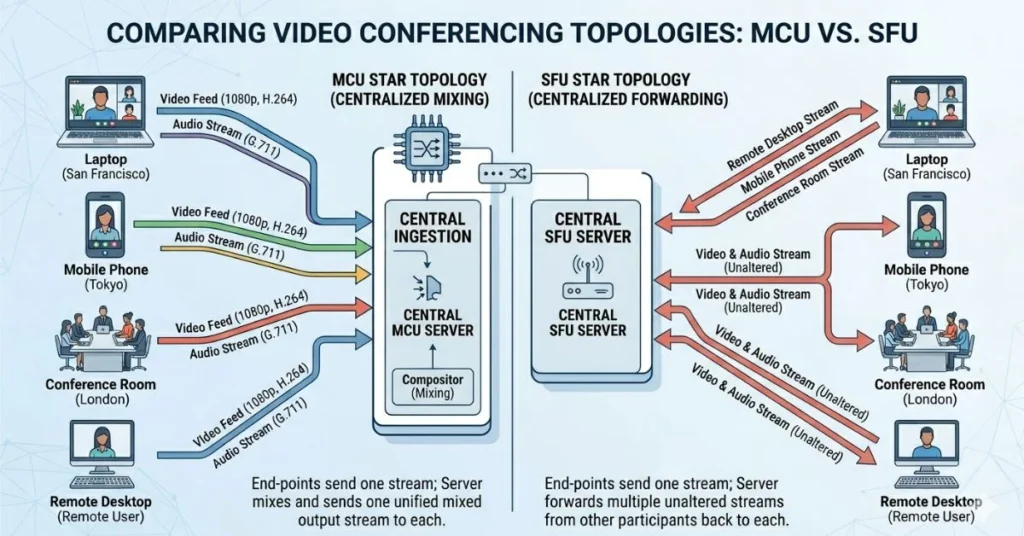
The difference in how these two systems handle media is fundamental. Unlike SFU, the MCU central server acts as a mixer — combining all received streams into one stream. All participants then consume this one mixed stream instead of subscribing individually to each participant’s stream.
SFUs are software applications that route and forward video streams between participants in a call. Unlike MCUs, which combine streams, SFUs forward packets selectively per recipient. This avoids unnecessary transcoding and scaling.
Which means the endpoint device does more work in an SFU model — it receives multiple streams and handles layout rendering locally. In an MCU model, the server does the heavy lifting and the device receives one clean output. For low-powered endpoints or environments where device processing capacity can’t be assumed, the MCU model wins.
While SFUs and cloud-based systems dominate large-scale conferencing due to scalability and efficiency, MCUs excel in environments requiring reliability, legacy device support, or strict compliance.
Healthcare organizations, government agencies, and financial institutions — sectors where regulatory frameworks govern data handling and where legacy hardware investments run deep — still lean on MCU infrastructure for exactly those reasons.
Hardware vs Software MCUs: The Deployment Split
Not all MCUs live in a rack. The technology has split into two distinct deployment models.
Hardware MCUs are physical appliances — purpose-built servers designed to handle intensive media processing at scale. They deliver reliable, consistent performance and are often chosen by large organizations with dedicated AV infrastructure. The downside is cost: upfront hardware investment plus ongoing maintenance and limited flexibility when scaling unexpectedly.
Software MCUs flip that equation. They run on standard servers or cloud infrastructure, can be spun up on-demand, and support virtualization. The MCU connects all users of a video conferencing system within a single network and solves audio/video switching tasks, coordinates user devices and software, and interacts with an H.323 gatekeeper that manages calls and performs many other important functions.
The drift toward cloud-based MCU functionality is accelerating. A cloud service like Microsoft Teams might use an SFU for standard participants but leverage cloud-based MCU functionality to transcode and include a legacy Poly room system connecting via SIP. Amazon Chime SDK and Azure Communication Services provide developers with building blocks that can function as an SFU or MCU as needed, showcasing how these core functions are expanding into flexible, API-driven cloud services.
That hybrid model — SFU for scale, MCU capability for compatibility — is increasingly where enterprise architecture lands.
Real-World Use Cases Where the Multipoint Control Unit Is Still the Right Choice
A few scenarios where defaulting to an SFU would create real problems:
Government and defense conferencing — environments requiring end-to-end encryption, strict access controls, and hardware-enforced security boundaries. MCUs built to classified standards remain the only compliant option in many of these contexts.
Healthcare telemedicine at scale — multi-site clinical consultations involving specialists across different hospital systems, often running on different video platforms. MCU systems pair up with other infrastructure like gatekeepers and gateways, allowing for more capabilities. That interoperability layer matters when no single platform controls every endpoint.
Broadcasting and live production — environments where the MCU’s centralized mixing capability translates directly to broadcast-quality output for live streaming or recording. The compositor functionality that MCUs provide is purpose-built for this.
Enterprise rooms running legacy H.323 hardware — companies that invested significantly in dedicated conference room systems don’t necessarily want to write off that infrastructure. A multipoint control unit allows this multipoint capability to be made centrally available, with almost any number of people able to dial in when needed, while improving compatibility between old and new systems.
The Outlook for Multipoint Control Unit Technology in 2026 and Beyond

The MCU isn’t dying — it’s evolving. The sharp hardware-only, premise-based deployment model is fading, yes. But the core function — centralized media processing, mixing, and distribution — is being absorbed into cloud platforms and hybrid architectures rather than abandoned.
AI integration is the next frontier. Early adopters in this space report that AI-assisted mixing — where the MCU uses voice and visual recognition to dynamically switch focus, adjust layouts, and suppress background noise — is already moving from experimental to deployable. The intelligence layer sitting above the media processing stack is making MCU functionality smarter without restructuring its fundamental architecture.
For platform developers and network engineers, the practical path forward is rarely a pure MCU or pure SFU choice. Hybrid architectures that route standard cloud participants through SFU infrastructure while bridging legacy or compliance-sensitive endpoints through MCU nodes represent where enterprise conferencing infrastructure is heading in 2026.
Understanding the multipoint control unit, then, isn’t just historical context. It’s the foundation for making informed decisions about how to build communication systems that are scalable, compatible, and future-ready.
For a deeper technical overview of how MCU architecture fits into broader videoconferencing infrastructure, the Wikipedia article on multipoint control units provides a solid reference point grounded in the relevant IEEE standards.
Frequently Asked Questions
1. What does a multipoint control unit actually do in a video call?
It receives audio and video streams from all participants, mixes or switches them into a unified output, and redistributes that output to every endpoint on the call. This makes multi-participant conferencing possible without every device having to connect to every other device directly.
2. Is an MCU the same as a conference bridge?
Functionally, yes — the terms are often used interchangeably. A conference bridge is the broader concept; the MCU is the specific hardware or software component that performs the bridging function for video and audio streams.
3. Why are SFUs replacing MCUs in many modern platforms?
SFUs don’t transcode or mix streams — they forward them selectively, which requires far less server processing power and scales to thousands of participants far more cheaply. For cloud-native platforms optimizing for scale and cost, SFU is the more practical architecture.
4. When should an organization still choose an MCU over an SFU?
When legacy endpoint compatibility is required, when regulatory compliance demands centralized processing, when broadcasting or recording high-quality mixed output is a priority, or when device-side processing capacity can’t be assumed across all participants.
5. Can MCU and SFU architectures coexist in the same conferencing system?
Absolutely — and this is increasingly common. Platforms like Microsoft Teams and AWS Chime SDK use hybrid approaches where SFU handles standard cloud participants and MCU-style processing handles transcoding for legacy room systems or compliance-specific endpoints.
