
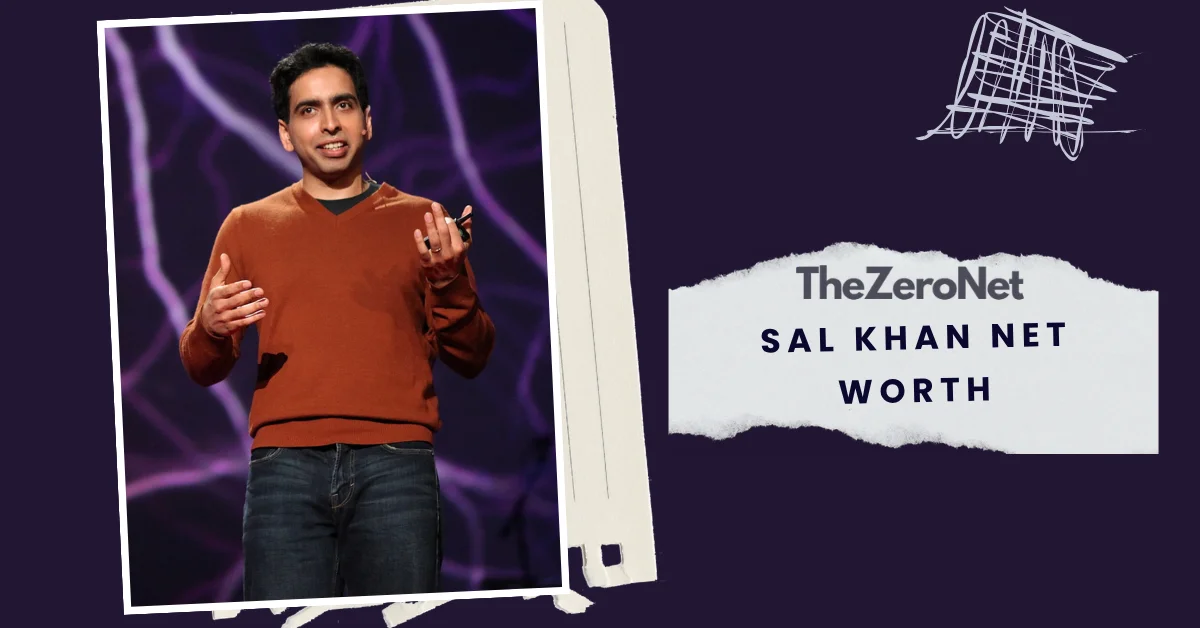

Sal Khan net worth is one of the most misunderstood figures in edtech — because the man built a platform used by 180 million people worldwide and deliberately structured it so he couldn’t get rich from it. That tension, between enormous cultural value and genuine financial ambiguity, is exactly what makes his story worth understanding.
| Attribute | Details |
|---|---|
| Full Name | Salman Amin Khan |
| Date of Birth | October 11, 1976 |
| Age | 49 (as of 2026) |
| Place of Birth | Metairie, Louisiana, USA |
| Nationality | American |
| Profession | Educator, Entrepreneur, Author |
| Spouse/Partner | Umaima Marvi (married 2004) |
| Children | 3 |
| Net Worth (Est.) | $2M–$10M (conservative, verified-source range); up to $300M+ (aggregator estimates — unverified) |
| Years Active | 2006–present |
| Notable For | Founding Khan Academy; pioneering free online education at global scale |
| Latest Venture | Khanmigo (AI tutor, launched 2023) |
Also Read: Gary Brecka Net Worth: What the Lawsuits, Labs, and Loyal Clients Actually Reveal
Sal Khan’s Early Life: Three MIT Degrees and a Cousin Who Needed Help
He grew up in Metairie, Louisiana — a suburb of New Orleans — in a household shaped by immigrant ambition. His father, Fakhrul Amin Khan, was from what is now Bangladesh. His mother, Farida Begum, raised him in a modest apartment while his father worked. It wasn’t a wealthy start. But the academic firepower showed early.
Khan attended Grace King High School in Metairie, where, as he’s recalled in public talks, some classmates were headed to prison and others to top universities. He was firmly in the second group.
What followed is the kind of academic record that makes other overachievers uncomfortable:
- Bachelor’s degrees in mathematics and electrical engineering/computer science — MIT, 1998
- Master of Engineering in electrical engineering/computer science — MIT, 1998
- MBA — Harvard Business School, 2003
Three degrees from two of the world’s most selective institutions. That’s not a resume. That’s an argument. And it set up everything that came next — including the decision to walk away from the career it was supposed to guarantee.
Career: From Hedge Fund Analyst to Free-Education Evangelist
Here’s the deal. Sal Khan spent years doing exactly what MIT and Harvard groomed him to do. From 2003 until late 2009, he worked as a hedge fund analyst at a Boston-based firm that later relocated to Palo Alto. He was on a clear financial trajectory. Then his cousin Nadia struggled with unit conversion in math class.
That moment in 2004 — tutoring Nadia by phone and annotated notepad — triggered a chain reaction nobody predicted. By 2006, Khan was tutoring 15 family members and friends remotely. He started posting YouTube videos to scale the lessons. By early 2009, tens of thousands of students watched daily. His web host kept crashing from the traffic load.
He quit the hedge fund in 2009. He wrote about it later in Fortune: he was “unbelievably naive,” running a one-person operation from a closet, despite outpacing MIT OpenCourseWare and Stanford combined on YouTube views.
Key career milestones:
- 2004 — Begins tutoring cousin Nadia via phone and interactive notepad
- 2006 — Starts uploading YouTube tutorial videos; tutoring 15 people remotely
- 2008 — Officially incorporates Khan Academy as a nonprofit
- 2009 — Quits hedge fund to run Khan Academy full-time
- 2010 — Receives early grant from the Bill & Melinda Gates Foundation
- 2012 — Featured on the Forbes cover; named to TIME 100 Most Influential People; delivers MIT commencement address (youngest in 30 years)
- 2012 — Publishes The One World Schoolhouse, his book on mastery-based learning
- 2014 — Founds Khan Lab School, a private in-person school in Mountain View, CA
- 2023 — Launches Khanmigo, an AI-powered tutor built on OpenAI’s GPT-4
- 2024 — Publishes Brave New Words, focused on AI and the future of education
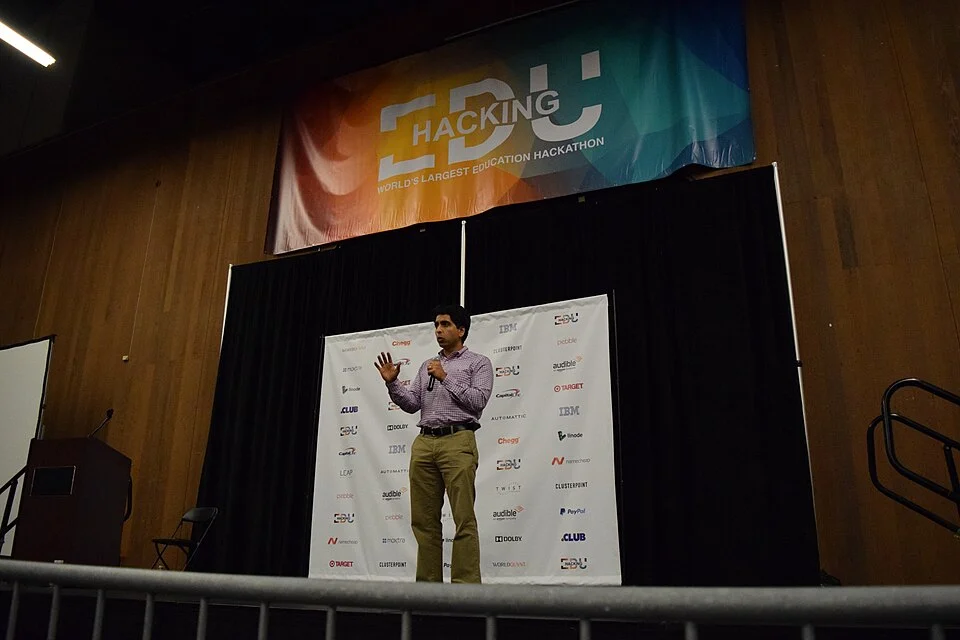
Alexlcory, CC BY-SA 4.0 https://creativecommons.org/licenses/by-sa/4.0, via Wikimedia Commons
And that’s the thing: every conventional step in his career after 2009 was a downgrade on paper. He traded analyst income for nonprofit CEO pay. He traded equity upside for a 501(c)(3) structure with no ownership stake. He made those choices deliberately — which is precisely why Sal Khan net worth is so hard to calculate.
Sal Khan Net Worth and Earnings: The Nonprofit Problem
Estimated net worth range: $2M–$10M (conservative, verified-source basis)
Let’s be clear about what the public record actually shows — and what it doesn’t.
Khan Academy is a registered 501(c)(3) nonprofit. It has no equity valuation. There are no shares. Sal Khan cannot monetize the platform the way a for-profit founder would. The IRS Form 990 filings — the primary verified financial disclosure for U.S. nonprofits — confirm his CEO compensation.
Verified salary data (IRS Form 990, publicly available):
- 2018: approximately $824,000 (salary plus additional compensation)
- 2019: approximately $839,000
These are the only figures grounded in publicly available verified financial disclosure.
How the Money Actually Works
Khan’s income streams, as reasonably reconstructed from available sources:
- CEO salary — Verified at ~$824K–$839K annually (2018–2019 IRS filings). Likely higher by 2024–2026 given Khan Academy’s expanded operating budget, but no updated public filing data was accessible at time of writing.
- Book advances and royalties — The One World Schoolhouse (2012) and Brave New Words (2024) both generated advance income from major publishers. Advance figures were not publicly disclosed.
- Speaking fees — Khan commands premium rates at global conferences and institutional events. No public figure confirmed.
- Personal investments — Khan worked in finance for six years before founding Khan Academy. Any investment portfolio from that era is entirely private and unconfirmed.
Khan Academy’s own finances are more transparent: IRS 990 data via ProPublica shows the organization reported $28.1M in revenue and $38.8M in expenses for fiscal year 2024, with $127M in total assets.
The Peer Comparison Table
| Name | Est. Net Worth | Primary Source | Notes |
|---|---|---|---|
| Jimmy Wales (Wikipedia founder) | ~$1M–$5M | Industry benchmark estimate | Also chose nonprofit model; minimal personal monetization |
| Craig Newmark (Craigslist founder) | ~$400M | Various verified press | Retained equity in private for-profit entity |
| Daphne Koller (Coursera co-founder) | ~$100M+ | Industry benchmark estimate | For-profit edtech; equity stake possible |
| Scott Heiferman (Meetup founder) | Not publicly confirmed | No verified disclosure | Private company; no public filing |
| Priscilla Chan | Billionaire range | Verified press | Co-leads Chan Zuckerberg Initiative (hybrid nonprofit/LLC) |
The contrast is direct: founders who chose for-profit structures retained enormous equity value. Khan chose otherwise.
Also Read: Travis Pastrana Net Worth: How a Daredevil Built a $25 Million Empire
Uncomfortable Truth
The figures most frequently cited for Sal Khan net worth — ranging from $260M to $710M — come from aggregator websites with no sourcing transparency. None cite IRS filings, verified financial disclosures, court records, or named-reporter journalism. One aggregator claims his net worth exceeds $6 billion, which is arithmetically impossible given Khan Academy’s structure and his verified salary history. These numbers are fabricated. Readers should treat them as such.
Unanswered Question
Did Sal Khan make personal investments in edtech or AI ventures during or after his hedge fund years? Any such portfolio is entirely private. There’s no public record of real estate holdings, angel investments, or private equity stakes — but absence of evidence isn’t evidence of absence. His actual wealth may be meaningfully higher than verified salary data alone would suggest. It may also not be. Without a verified financial disclosure beyond the Form 990, nobody knows.
Methodology Transparency
Sources used:
- IRS Form 990 data via ProPublica’s Nonprofit Explorer (executive compensation, Khan Academy revenue/expenses)
- MIT News Office (career and education history)
- Fortune (first-person account of leaving hedge fund)
- Harvard Business School press release (educational background confirmed)
- Carnegie Mellon University lecture record (career timeline confirmed)
- Khan Academy blog and press releases (Khanmigo growth data)
- Chalkbeat verified journalism (Gates Foundation grants, Khanmigo expansion)
Excluded:
- CelebrityNetWorth, TheRichest, Wealthy Gorilla, and similar aggregator sites (figures unverifiable, sourcing absent)
- Saint Augustine’s University article citing $710M — no primary source cited, methodology opaque
- Any figure not traceable to a named source or verifiable public document
Personal Life: The Man Behind the Whiteboard
Sal Khan married Umaima Marvi in 2004. She is a physician. They have three children together and live in the San Francisco Bay Area. Khan has kept his family largely out of public view — an unusual choice for someone with his public profile.
His personal interests track with his work. He’s an Aspen Institute board member. He launched Schoolhouse.world, a free peer-tutoring platform, as a parallel nonprofit venture. He’s not known for luxury spending, flashy philanthropy events, or the lifestyle markers that usually accompany a net worth profile. Which is either admirable or frustrating, depending on what you’re looking for.
One thing worth noting: his wife is a doctor. Their household income is meaningfully higher than his salary alone — another variable that doesn’t show up in any net worth estimate.
Philanthropy: Khan Academy Is the Philanthropy
Sal Khan’s philanthropic output is inseparable from his professional work. He built a free education platform and has run it for over 15 years without charging users. That’s the philanthropic act.
Beyond the platform itself:
- Khan Lab School — A private, in-person school in Mountain View, CA focused on mastery-based learning, functioning as an R&D lab for Khan Academy’s pedagogical approach
- Schoolhouse.world — A free nonprofit peer-tutoring platform, launched separately from Khan Academy
- Khanmigo access subsidies — Khan Academy has received grants from the Gates Foundation, Google.org, and Bank of America specifically to subsidize Khanmigo access for Title I schools and under-resourced districts
The Gates Foundation committed $12M to Khan Academy in 2020 specifically for grades 3–12 math development. This is documented in verified journalism from Chalkbeat.
Controversies: The Khanmigo Reality Check
Sal Khan positioned Khanmigo as a breakthrough in personalized AI tutoring when it launched in March 2023. The early growth numbers supported the narrative — from 68,000 pilot users in 2023–24 to more than 700,000 in 2024–25.
However, in an April 2026 interview with Chalkbeat, Khan himself acknowledged that Khanmigo had not met early classroom expectations. The honest admission is notable. Most edtech founders don’t say their product underperformed in public.
No personal financial controversies, legal disputes, or ethical violations appear in any verified public record. His controversy is largely professional — the gap between what AI tutoring promised and what it’s delivered so far.
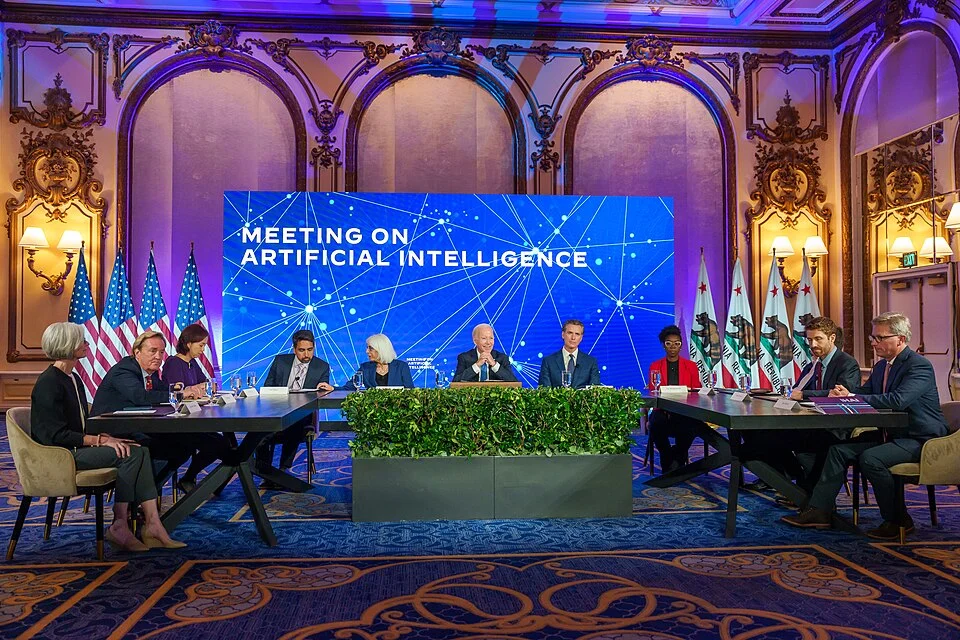
The White House, Public domain, via Wikimedia Commons
Legacy: What It Costs to Give Something Away
Sal Khan’s legacy is already settled in one sense: he built the largest free educational resource in human history and deliberately structured it so he couldn’t profit from its scale. That’s a choice most people claim they’d make and almost nobody actually does.
Which brings us to an uncomfortable comparison. A founder with Khan Academy’s reach — 180+ million registered users, 190 countries, 56 languages — would be worth billions in a for-profit model. Khan isn’t. He made that trade consciously, and the public record shows he’s maintained it.
The one tweet-worthy observation about Sal Khan net worth: the more his platform grows, the less his personal finances matter — because the value he’s created is structurally impossible for him to extract.
That’s either the most selfless model in tech history or the most financially naive one. Probably both.
Sal Khan’s Current Activities (as of 2026)
- Serving as founder and CEO of Khan Academy
- Overseeing Khanmigo expansion toward a projected 1 million users in 2025–26
- Operating Khan Lab School in Mountain View, CA
- Running Schoolhouse.world as a parallel nonprofit
- Authoring and speaking — Brave New Words (2024) positions him as an AI-in-education thought leader
- Board member, Aspen Institute
Conclusion
Sal Khan net worth may never be definitively confirmed — and that’s by design. He built a nonprofit. He took a salary. He declined the equity path that would have made him a billionaire several times over. The verified data puts his compensation in the range of a well-paid nonprofit CEO, not a tech founder cashing out.
What the numbers can’t capture is the trade he made — and kept making, year after year, as Khan Academy grew into something genuinely rare. By 2026, 180 million people use what he built. None of them pay for it. And he still doesn’t own it.
That’s the real Sal Khan net worth story.
Read Our Latest Feature: DT Solutions: What Businesses Get Wrong in 2026
Frequently Asked Questions About Sal Khan
What is Sal Khan’s net worth?
No verified financial disclosure places Sal Khan’s personal net worth at a specific figure. His CEO salary at Khan Academy was confirmed at approximately $824,000–$839,000 annually via IRS Form 990 filings from 2018–2019. Aggregator sites cite figures ranging from $260M to over $700M, but none of these are traceable to verified primary sources. A conservative evidence-based estimate would place his net worth in the low single-digit millions, with meaningful uncertainty on the upside.
How does Sal Khan make money?
His primary documented income source is his CEO salary at Khan Academy, a 501(c)(3) nonprofit. Additional income streams include book advances and royalties (The One World Schoolhouse, Brave New Words), speaking fees at conferences and institutions, and potentially personal investments — though none of the latter are publicly confirmed. Because Khan Academy is a nonprofit with no equity, he cannot profit from the organization’s growth the way a for-profit founder would.
Is Sal Khan married?
Yes. Sal Khan has been married to Umaima Marvi since 2004. She is a physician. They have three children together and live in the San Francisco Bay Area.
How old is Sal Khan?
Sal Khan was born on October 11, 1976. He is 49 years old as of 2026.
What degrees does Sal Khan hold?
He holds three degrees from MIT: a Bachelor of Science in mathematics, a Bachelor of Science in electrical engineering and computer science, and a Master of Engineering in electrical engineering and computer science — all completed in 1998. He also holds an MBA from Harvard Business School (2003).
Has Forbes verified Sal Khan’s net worth?
No. Forbes featured Sal Khan on its cover in 2012 with the headline “The $1 Trillion Opportunity” — a reference to the potential economic value of free global education, not his personal net worth. No Forbes or Bloomberg verified financial figure for Sal Khan’s personal wealth exists in the public record.
What is Khanmigo and is it successful?
Khanmigo is an AI-powered tutoring tool built on OpenAI’s GPT-4, launched by Khan Academy in March 2023. It grew from approximately 68,000 pilot users in 2023–24 to over 700,000 in 2024–25, with projections toward 1 million users in 2025–26. However, Sal Khan acknowledged in a 2026 interview that the tool had not fully met early classroom expectations — a notable moment of public candor from a tech founder.
Why is Sal Khan’s net worth so hard to verify?
Because his primary asset — Khan Academy — is a 501(c)(3) nonprofit with no equity valuation. Unlike for-profit startup founders, Khan cannot convert platform growth into personal wealth. His publicly available financial data is limited to IRS Form 990 filings showing CEO compensation. Any personal investments or other assets are entirely private and unconfirmed by any public record.
Net worth figures are estimates based on publicly available data and industry benchmarks — not verified financial disclosures.
Featured Image: Steve Jurvetson, CC BY 2.0 https://creativecommons.org/licenses/by/2.0, via Wikimedia Commons
